
Updated August 2026
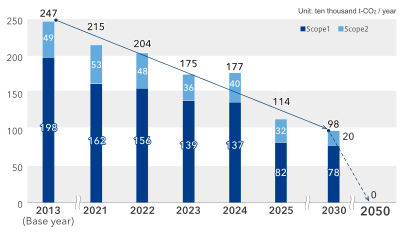
In fiscal 2020, the Denka Group declared its goal of becoming carbon neutral by fiscal 2050. As a milestone toward this goal, we are aiming to reduce CO 2 emissions by 60% (compared to fiscal 2013) by fiscal 2030.
In fiscal 2025, our annual emissions from the Company and Group companies totaled 1.14 million tons, achieving a 46% reduction compared to fiscal 2013, thanks to the transformation of our business portfolio, promotion of energy conservation, and introduction of renewable energy (hydroelectric power).
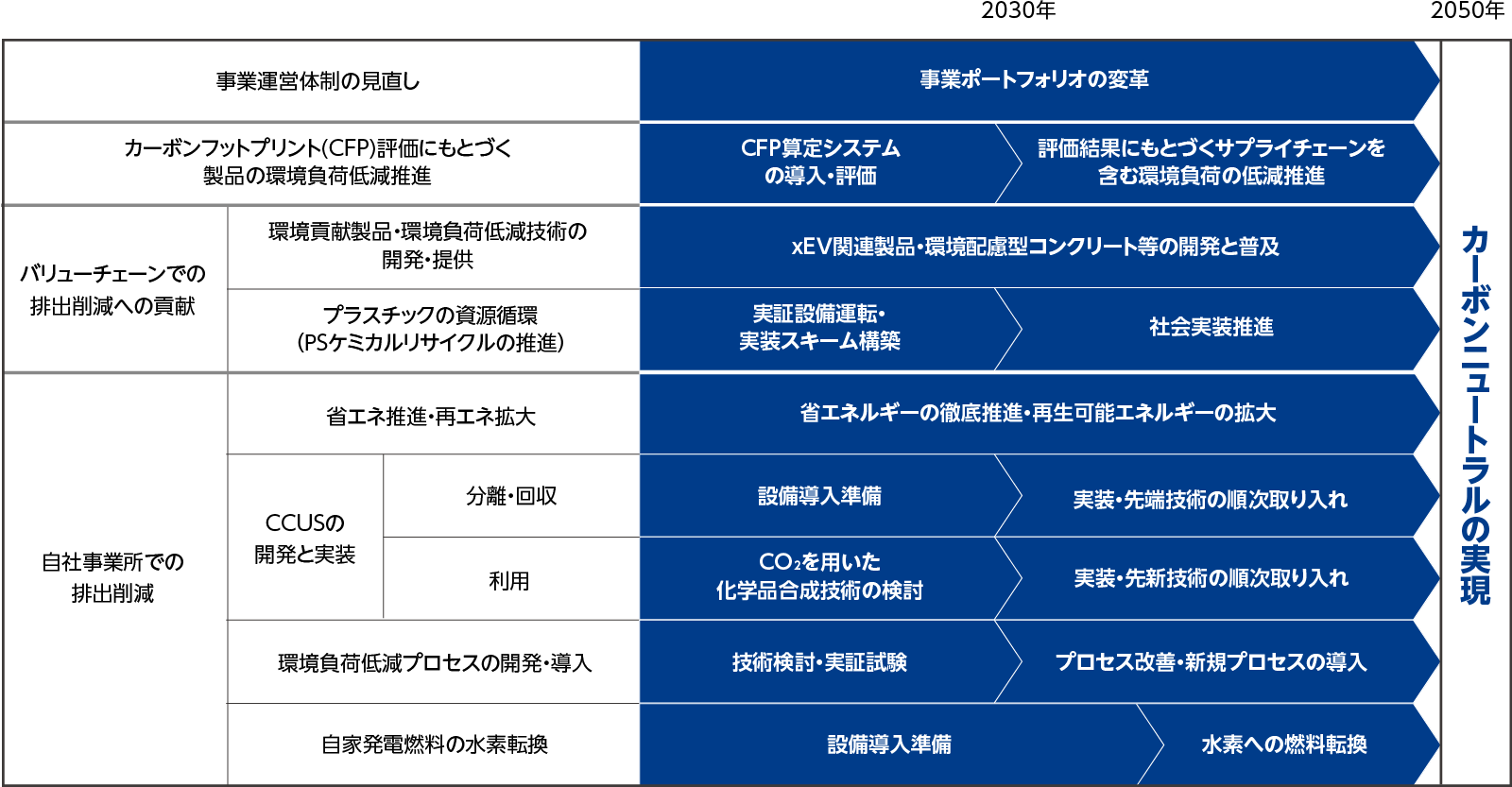
Going forward, we will continue and promote the following measures as initiatives toward achieving carbon neutrality.
| Transforming our portfolio | Through a transformation of our portfolio, including withdrawal from the cement business, we will reduce our CO 2 emissions. |
|---|---|
| Energy conservation | The Omi Plant (which began operation in October 2020) and Chiba Plant (which began operation in June 2022) have introduced high-efficiency gas turbine power generators. We will continue to promote thorough energy conservation at each of our business sites. |
| Further introduction of renewable energy | Currently, we have 17 hydroelectric power generation facilities (one of which started operation in FY2022). We are also promoting the introduction of solar power generation at several of our business sites to further expand our use of renewable energy. |
With an eye toward collaborations with local communities and surrounding companies, we are exploring and examining the possibility of recovering CO 2 and repurposing it as a chemical product. At the same time, we will also work on the introduction and development of environmental burden reduction processes aimed at reducing generated CO 2 emissions. By combining these technological developments with collaboration with external parties, we will steadily reduce the CO 2 emissions generated by our company.
Medium- to long-term targets for reduction of greenhouse gas emissions
Roadmap for achieving carbon neutrality
The Denka Group is addressing the issues of reducing environmental burden, recycling waste plastics, and conserving biodiversity through its products and technologies in pursuit of fulfilling its social responsibilities as a chemical manufacturer.
In collaboration with our consolidated subsidiary TOYO STYRENE CO., LTD., we have commenced the commercialization of the chemical recycling of polystyrene resin. We have introduced technology from Agilyx Corporation in the United States and decided to construct a plant (annual processing capacity: approximately 3,000 tons) at our Chiba Plant, which has started operation in March 2024. As a contribution to the environment, we expect that the application of the chemical recycling process will reduce CO 2 emissions by approximately 40% on a life cycle basis compared to the existing simple incineration process, taking into account the new emissions (including the reuse of by-products) generated by this facility. We will continue our efforts toward the early realization of full-scale implementation.

Denka is analyzing the relationship between its business and nature and identifying priority issues using the LEAP Approach * based on the TNFD Recommendations. We conducted on-site surveys and ENCORE analyses at nine domestic sites to understand our points of contact with nature and our dependencies and impacts on it. In particular, we have prioritized the Omi Plant, where we conduct scenario analyses to financially assess the risks and impacts associated with hydroelectric power generation and the effects on ecosystems, and develop countermeasures. Specifically, we aim to implement water improvement through forest conservation and maintenance and the protection of endangered species. We are also conducting proximity assessments with KBAs (Key Biodiversity Areas) and collaborating with local governments to strengthen conservation activities tailored to regional characteristics. Going forward, we will continue to enhance our analyses and countermeasures to contribute to the maintenance and improvement of the natural environment.
Denka is working towards the development of environmentally conscious products in its quest for a sustainable future. Our environmentally friendly products play an important role in protecting the global environment and realizing a sustainable society. For details, please refer to the list of SDGs contribution products.
Click here for list of products that contribute to the SDGs
The Company has developed a carbonization admixture, “LEAF,” which utilizes industrial waste as a raw material, using the technology of special cement admixtures that we have cultivated over many years. “LEAF” has the characteristic of actively reacting with and fixing CO 2. By formulating this “LEAF” into an environmentally friendly concrete, “CO 2-SUICOM,” which was jointly developed by Kajima Corporation, Chugoku Electric Power Co., Inc., Randes Co., Ltd., and the Company, CO 2 is absorbed and fixed during the curing of the concrete, aiming for a net reduction of CO 2 emissions from the cement manufacturing process.
Our high thermal conductivity and high toughness ceramic substrate "SN Plate" has about 4 times the thermal conductivity of alumina and is a material based on high toughness silicon nitride (Si3N4) with excellent mechanical properties. By imparting high conductivity to the mechanical properties, it is used as a lightweight power module substrate for electric vehicles and electric railways, which require high reliability. We will contribute to the reduction of CO 2 emissions by supporting the electrification (xEV) of the automotive industry, which is expected to accelerate in the future, with our material technologies.
 Road boundary block
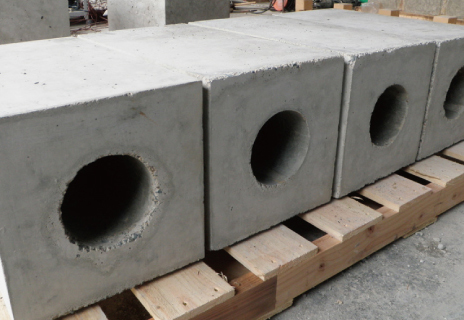 Fence foundation blocks
 DENKA SN PLATE
To maintain an environment in which society and ecosystems can continue to survive into the future, Denka Group aims to contribute to achieving the goals of the Paris Agreement, an international framework, and to achieve net-zero greenhouse gas emissions (carbon neutrality) by fiscal 2050. To achieve this, we are promoting energy conservation and expanding the use of renewable energy, primarily hydroelectric power, while also working to reduce CO 2 CCUS: Separating and capturing carbon dioxide from emission sources * We will also take on the challenge of introducing innovative technologies such as the use of hydrogen, a clean energy source. Furthermore, in order to reduce emissions at our own business sites and contribute to decarbonizing society as a whole, we will promote the development and provision of environmentally friendly products and technologies that reduce the environmental impact, and will strengthen our efforts to recycle resources by introducing new plastic recycling methods.

Consideration for the global environment Support for the RC World Charter (2014 version) ...
Denka accurately understands the environmental burden substances emitted from the production facilities of Group companies and is working on their continuous reduction. The substances targeted include CO2,...
Greenhouse Gas Emissions Zero emissions initiatives ...
Addressing risks and opportunities Addressing risks and opportunities
Expansion of renewable energy and introduction of environmentally friendly power generation technologies In accordance with the...
Company's Approach to Biodiversity The Company recognizes that biodiversity is the basis of the ecosystem that supports human life and corporate activities. The Company also recognizes that the loss of biodiversity due to human activities is a serious global issue. Therefore, the Company is committed to protecting biodiversity and promoting the sustainable use of biological resources in its corporate activities. The Company will also contribute to the conservation of biodiversity through its business activities.
Approach to Resource Circulation (Circular Economy) Chemical Recycling ...
Environmental conservation costs Environmental conservation effects Economic effects ...
Data Scope: 8 locations of Denka's head office (80% of Denka product sales are manufactured) ...
2025 Main Substances Emissions and Water Usage Ratios Headquarters ...