
March 2025 update
The Denka Group places importance on compliance with international human rights standards and strives to act in accordance with the United Nations "Guiding Principles on Business and Human Rights." As part of these efforts, the Denka Group Human Rights Policy was established to concretely formulate measures to eliminate human rights violations in all corporate activities, and was approved and established by the Board of Directors in September 2023.
This Human Rights Policy applies to all officers and employees of the Denka Group, and requests that this Policy be supported and respected by our business partners and suppliers. Furthermore, as a signatory of the United Nations Global Compact, the Denka Group supports the ten principles set forth by this initiative and will continue to fulfill its responsibilities.
The Denka Group (“Denka”) aims to contribute to society by providing innovations and solutions under our Vision, consisting of Core value, Purpose and Mission, as the basis of business activities of all executives and employees of Denka. Denka understands that human rights are important matters in all our business activities. Denka has established this policy to fulfill our responsibility to respect human rights and to contribute to overcome human rights issues in accordance with the "Denka Group ESG Basic Policy" and the "Denka Group Corporate Ethics Policy” and will strive to achieve our objectives as set forth below.
This policy was approved by the Board of Directors on September 11, 2023.
Established on September 11, 2023
Revised on March 10, 2025
Ikuo Ishida
President and CEO
Denka Company Ltd.
Denka has identified prominent human rights risks that may arise in the course of corporate activities. In identifying risk items, we conducted hearings with each business division, management division, and labor union, and extracted 10 risk items to be addressed as priorities.
In the future, we will continue to conduct hearings to expand the scope of targets, promote response measures for prevention and mitigation, and aim to establish a human rights due diligence process.
| Category | Risk Items |
|---|---|
| Occupational health and safety | Human rights in work environment (health and safety) |
| Power Harassment | Risk of Power Harassment occuring among employees |
| Risks of Power Harassment on employees of suppliers (including their business partners ) | |
| Risks of Power Harassment on our employees by a customer | |
| Long working hours | Risks of long working hours and overwork |
| Freedom to relocate residence | Risks of violating freedom of relocating residence by forced transfer of work location or job |
| Rights of Indigenous people and local residents | Risks of violating freedom of relocating residence by forced transfer of work location or job |
| Consumer safety and the right to know | Risks of violating the right to know of purchasers and consumers due to misinformation related to products |
| Occupational health and safety | Human rights risks related to health and safety in supplier’s work environment |
| Forced Labor and Child Labor | Risks of serious incidents of forced and child labor occurring in the production sites of raw materials, etc., and purchasers (and plants) |
Denka has organized a human rights working team with relevant departments and is promoting efforts to respect human rights in a coordinated manner. The progress of these efforts is discussed at The Sustainability Committee and reported to the Board of Directors twice a year.
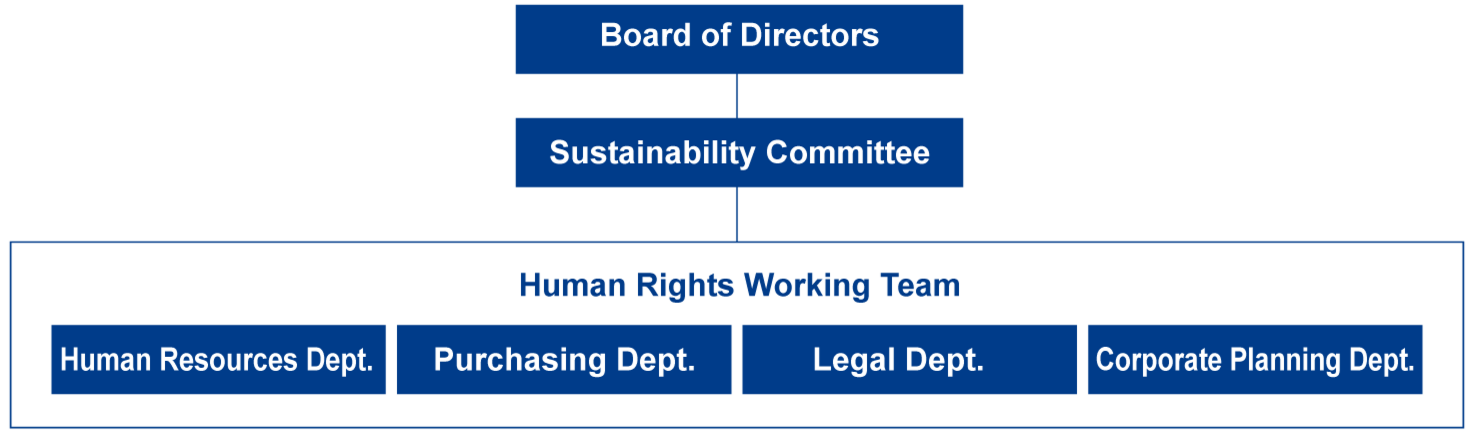
Denka conducts ongoing dialogue and discussions with relevant internal and external stakeholders to identify and address potential and actual human rights issues, as stated in Article 7 of the Denka Group Human Rights Policy.
In order to correctly understand the human rights risks of major suppliers, we send a Self-Assessment Questionnaire (SAQ) based on the 10 Principles of the United Nations Global Compact (various risks including human rights risk) to all suppliers and request their responses. We list the SAQ results of each company by item, and for suppliers that do not meet a certain score, we will plan and implement dialogue and discussions for improvement. In addition, we request that new business partners agree to our CSR Procurement Policy, which states our commitment to human rights.
The Denka Group conducts explanatory meetings for the "Denka Group Human Rights Policy" and "Future Human Rights Initiatives" for all employees. In addition, we conduct e-learning together with Denka's compliance training, monitor employees' understanding of human rights, and link this to the next actions.
In the future, we will continue to raise awareness and promote the "Denka Group Human Rights Policy" among all Group employees, and systematically address human rights due diligence and human rights remedy mechanisms together with third parties with expertise in these areas.
The Denka Group Ethics Policy state that the Denka Group must maintain good human relationships and obliges all officers and employees of the Denka Group to respect individual human rights. Furthermore, the "Standards of Business Conduct" state that officers and employees of the Denka Group must recognize that laws, customs, traditions, and cultures differ from country to country and region to region, and that it is important to act as a good corporate citizen in all countries and regions where the Denka Group conducts business with a high level of ethics. Moreover, the Business Conduct Guidelines state that it is important for officers and employees of the Denka Group to be treated fairly without discrimination in all aspects of employment, including job placement, promotion, transfer, and training opportunities, based on the abilities and aptitudes required for the job, as well as laws and regulations, regardless of ethnicity, race, gender, religion, nationality, age, physical disability, or gender identity. Furthermore, the Business Conduct Guidelines clarify specific obligations and prohibitions that must be observed by all officers and employees of the Denka Group to ensure compliance with labor laws and regulations, provide equal employment opportunities and treatment without discrimination, and prevent harassment in the workplace. In particular, training materials for preventing workplace harassment include specific examples of power harassment and sexual harassment in accordance with guidelines set forth by the Ministry of Health, Labour and Welfare, and are carefully designed to prevent harassment in the Denka Group.
In addition, Denka signed the United Nations Global Compact in June 2023. Denka supports the 10 Principles of this initiative, respects various other international standards regarding human rights, and contributes to addressing human rights issues through its business activities.
As stated in Article 3 of the Denka Group Human Rights Policy, Denka does not permit child labor or forced labor in any form. The same prohibition is also stipulated within the Denka Group Employment Regulations. As a preventative measure, we prevent the occurrence of child labor by ensuring that the age of employees in Japan is verified by means of a copy of their Certificate of Residence or Residence Card, which is submitted at the time of employment. In addition, to prevent forced labor, we do not restrict employees’ freedom of movement or keep important documents such as passports in custody.
Denka employees are organized into Denka labor unions, which have the right to collective bargaining. In addition to holding labor-management consultations three times a year, we hold monthly liaison meetings, valuing an appropriate relationship with labor unions and respecting the unions’ aims and ideas for protecting workers’ rights. In addition, active discussions on working conditions and the working environment for employees are held between labor and management, and we are actively working toward improvements. Through these activities, we aim to build sound labor-management relations based on mutual understanding and trust and to realize inclusive workplace environments.

The Denka Group Code of Ethics states, "Maintaining Good Human Relationships," and obliges all officers and employees of the Denka Group to respect individual human rights. Furthermore, the Denka Group Code of Ethics states, "Conducting Fair and...
As stated in Article 3 of the Denka Group Human Rights Policy, Denka does not tolerate any forms of child labor or forced labor. Such practices are also prohibited in the Denka Group Employment Regulations.
Employees of Denka have organized the Denka Labor Union, which has the right to collective bargaining. In addition to holding labor-management consultations three times a year, the company also holds monthly liaison meetings to maintain...
Creating Human Resource Value In the management plan "Mission 2030," we aim to strengthen our human resource development systems, promote diversity and inclusion, and...
What Denka Considers to be a “Specialist” Recruitment of Specialists Denka's HR System Employees' Proactive...
2022 Initiatives Conducting employee awareness survey Follow-up after employee awareness survey Employees who took employee awareness survey
Under the slogan "Bringing out your uniqueness to create Denka's uniqueness," the Denka Group aims to draw out the potential of each diverse employee working in the Denka Group and create new value as an organization.
Code of Conduct Promotion System Health Issues and Targets Initiatives for Achieving Health and Productivity Management Health KPI Setting ...
Activities in FY2024 (Company-wide Targets and Key Implementation Items) Basic Policy Code of Conduct Safety Management System ...
The Denka Group is committed to building partnerships with all of its business partners to strengthen mutually beneficial relationships, fulfilling its social responsibilities throughout the supply chain, and...
Minerals collected in conflict areas such as the African continent may be a source of funds for forces that promote conflict activities. Therefore, regulations such as the U.S. Dodd-Frank Wall Street Reform and Consumer Protection Act and European...
Building a sustainable supply chain Conducting buyer training Communicating with suppliers Establishing a system for managing supply chain CSR
In the event of unforeseen circumstances such as large-scale natural disasters (earthquakes, floods, etc.), sudden geopolitical events, or pandemics, Denka has established a system to ensure that its raw material supply chain is not disrupted...
Statement on Improving Medical Access Initiatives in Developing Countries for Pharmaceutical Development Proper Promotion of Pharmaceuticals ...
Employee composition Recruitment, employment, and labor unions Number of managers HR development training Diversity, equity...
Occupational accident data Occupational health and safety management system On June 14, 2023, Aomi...