
Updated August 2026
The Denka Group places importance on compliance with international standards on human rights and promotes actions based on the United Nations "Guiding Principles on Business and Human Rights." As part of these efforts, the Denka Group Human Rights Policy was established to present specific measures for eliminating human rights violations in all corporate activities, and was approved and established by the Board of Directors in September 2023.
This human rights policy applies to all officers and employees of the Company Group, and the Company also requests business partners and suppliers to support and respect this policy. Furthermore, the Company is working to raise awareness and ensure thorough understanding of the human rights policy through online training that all officers and employees take on a regular basis.
Furthermore, we have established and publicly announced human rights respect clauses in the "Denka Group Sustainable Procurement Basic Policy" and the "Denka Group Sustainable Procurement Guidelines" for our business partners. In addition, each Group company sends letters to its business partners to inform them of the Policy and Guidelines, and conducts proactive awareness-raising activities such as requesting their agreement through questionnaires.
Denka Group Sustainable Procurement Basic Policy and Guidelines
Furthermore, the Denka Group supports the 10 Principles set forth by the United Nations Global Compact and will continue to fulfill its responsibilities as a signatory of this initiative.
The Denka Group (“Denka”) aims to contribute to society by providing innovations and solutions under our Vision, consisting of Core value, Purpose and Mission, as the basis of business activities of all executives and employees of Denka. Denka understands that human rights are important matters in all our business activities. Denka has established this policy to fulfill our responsibility to respect human rights and to contribute to overcome human rights issues in accordance with the "Denka Group ESG Basic Policy" and the "Denka Group Corporate Ethics Policy” and will strive to achieve our objectives as set forth below.
This policy was approved by the Board of Directors on September 11, 2023.
Established on September 11, 2023
Revised on March 10, 2025
Ikuo Ishida
President and CEO
Denka Company Ltd.
Denka has identified significant human rights risks that may arise in the course of corporate activities and is taking appropriate measures in response. In identifying risk items, we conducted hearings with each business division, management division, and labor union in fiscal 2023, and conducted questionnaire surveys targeting domestic factories and offices in fiscal 2024. In fiscal 2025, we will expand the scope of our surveys to 14 group companies in Japan and overseas, and identify priority human rights risk items for the Denka Group as a whole.
In this survey, we conducted a wide-ranging investigation into risk items that should be considered in all business activities as a company, including labor issues, harassment, discrimination, forced labor, child labor, working hours, wage deficiencies, rights of local residents, and consumer safety and right to know. As a result, we recognized that the following are important human rights risks that the Group should prioritize in its efforts.
The Human Rights Working Team will confirm prevention and mitigation measures for the extracted risks and consider and implement corrective and preventive measures. In addition, for items and business sites with higher human rights risks, we will establish a human rights due diligence process across the Group, maintain it, and continue it while considering changes to the survey methods to conduct more in-depth surveys.
| Category | Risk Items |
|---|---|
| Occupational health and safety | Human rights risks in health and safety in the workplace |
| Human rights risks related to health and safety in supplier’s work environment | |
| Power Harassment | Risk of Power Harassment occuring among employees |
| Risks of Power Harassment on employees of suppliers (including their business partners ) | |
| Risks of Power Harassment on our employees by a customer | |
| Working hours | Risk of excessive working hours within the Company |
| Freedom to relocate residence | Risks of violating freedom of relocating residence by forced transfer of work location or job |
| Rights of Indigenous people and local residents | Risks of violating freedom of relocating residence by forced transfer of work location or job |
| Consumer safety and the right to know | Risks of violating the right to know of purchasers and consumers due to misinformation related to products |
| Forced Labor and Child Labor | Risks of serious incidents of forced and child labor occurring in the production sites of raw materials, etc., and purchasers (and plants) |
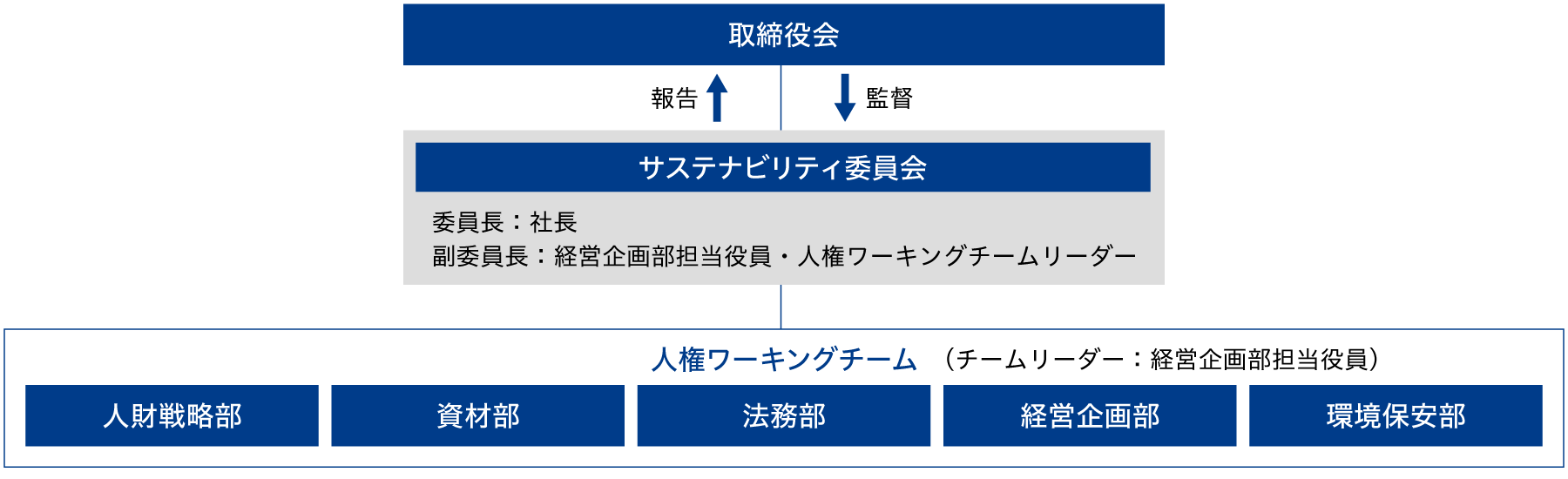
The Denka Group is promoting its efforts to respect human rights with the Executive Officer in charge of the Corporate Planning Department serving as the leader of the Human Rights Working Team. The main functions for respecting human rights are performed by the Human Rights Working Team, which consists of the Human Resources Strategy Department, Materials Department, Legal Department, and Corporate Planning Department, and is promoted in collaboration with each business base. The progress of these efforts is discussed at The Sustainability Committee and reported to the Board of Directors twice a year.
In addition, if any important issues regarding human rights are identified, the relevant department will summarize the causes of the issues, corrective actions, and measures to prevent recurrence, and report to the Board of Directors. The Board of Directors will determine future policies based on these reports.
Human Rights Action Plan Promotion Structure
Denka conducts ongoing dialogue and discussions with relevant internal and external stakeholders to identify and address potential and actual human rights issues, as stated in Article 7 of the Denka Group Human Rights Policy.
Establishment of grievance mechanisms Whistle-blowing system
Denka sends a Self-Assessment Questionnaire (SAQ) based on the 10 Principles of the United Nations Global Compact to all suppliers and requests their responses in order to correctly understand the human rights risks of major suppliers. The SAQ evaluates various risks including human rights risks and lists the results by item. For suppliers that do not meet a certain score, we are proceeding with dialogue and discussions for improvement, and have completed dialogue with 50% of the target suppliers in fiscal year 2025.
In addition, we request that new business partners agree to our Denka Group Sustainable Procurement Guidelines, which state the need to comply with human rights. Furthermore, in fiscal year 2025, we sent letters from Group companies to suppliers to inform them of these Guidelines, achieving a 100% agreement rate. We will continue to engage in dialogue with our business partners.
The Denka Group is raising awareness of the Denka Group Human Rights Policy among all employees and is working on human rights due diligence and human rights remedy mechanisms in collaboration with third parties with specialized knowledge in a planned manner.
When conducting human rights risk surveys, we hold pre-explanatory meetings for employees subject to investigation at our head office, factories, and business sites as well as at labor unions and Group companies, and conduct Q&A sessions and exchanges of opinions. We also conduct discussions on concerns and requests regarding human rights through hearings and questionnaires.
Furthermore, as part of employee training, we hold explanatory meetings on our human rights policy and initiatives, and conduct e-learning linked to compliance training to monitor employee understanding of human rights and connect this to the next actions.
The "Denka Group Code of Ethics" emphasizes "maintaining good interpersonal relationships" and obligates all Denka Group officers and employees to respect individual human rights. The "Business Code of Conduct" states the importance of Denka Group officers and employees acting as good corporate citizens in all countries and regions where Denka Group operates, while recognizing that laws, customs, traditions, and cultures differ from country to country and region to region, and maintaining a high level of ethical standards. Furthermore, it states the importance of Denka Group officers and employees being treated fairly and without discrimination in all aspects of employment relationships, including job placement, promotion, transfers, and training opportunities, based on the abilities and aptitudes required for their jobs, as well as in accordance with laws and regulations, regardless of ethnicity, race, gender, religion, nationality, age, disability, gender identity, sexual orientation, etc. In addition, the "Business Code of Conduct" clarifies specific obligations and prohibitions that all Denka Group officers and employees must adhere to in order to comply with labor laws, ensure equal employment opportunities and non-discriminatory treatment, and prevent workplace harassment. In particular, our in-house training text on preventing workplace harassment includes specific examples of power harassment, sexual harassment, customer harassment, SOGI harassment, etc., in accordance with the guidelines of the Ministry of Health, Labour and Welfare, and is carefully designed to prevent harassment incidents from occurring within Denka Group.
In addition, Denka signed the United Nations Global Compact in June 2023. Denka supports the 10 principles set forth by this initiative and respects other international norms concerning human rights, and will contribute to addressing human rights issues through its business activities.
As stated in the Denka Group Human Rights Policy, Denka complies with local laws and regulations of each country in which it conducts business activities, respects internationally recognized human rights principles, and actively works to reduce excessive working hours and overtime hours. Specific measures include the following.
Employees of Denka have organized the Denka Labor Union, which has the right to collective bargaining, and hold labor-management consultations three times a year. In addition, three times a year, the President and representatives of the Labor Union have opportunities to engage in dialogue regarding the Company’s management situation and initiatives, and monthly information exchange meetings are also held. The Company places importance on maintaining appropriate relationships with the Labor Union and respects the purpose and philosophy of the Labor Union in order to protect the rights of workers. Furthermore, active discussions are held between labor and management regarding working conditions and the working environment of employees, and efforts are made to improve these conditions. Through these activities, Denka aims to build sound labor-management relationships based on mutual understanding and trust, and realize a comfortable working environment.
The Denka Group is promoting various initiatives in accordance with the "Children's Rights and Business Principles" established by UNICEF, the United Nations Global Compact, and Save the Children.
Our Denka Group Human Rights Policy and Denka Group Basic Sustainable Procurement Policy clearly state our commitment to the elimination of child labor based on Principle 2: Child Labor. Furthermore, regarding Principle 3: Young Workers, Parents, and Caregivers, we are working to create systems and working environments that are easy for employees raising children to work in and that they find rewarding.
Moreover, based on Principle 10: Engagement with the Local Community and Governments, we hold factory tours and chemistry experiment classes for children at elementary, junior high, and high schools in the areas where our factories, offices, and research laboratories are located. In addition, we conduct a wide range of educational support initiatives, including workplace experience programs for high school and technical college students, sponsorship of science and technology contests, and outreach classes at universities on the theme of intellectual property education.
As the Denka Group, we are actively supporting the development of young people who will be responsible for the manufacturing of the future in accordance with our Denka Group Social Contribution Policy, which includes the promotion of education, academia, and culture.

Denka Group Human Rights Policy Denka Group Human Rights Material Risks ...
Creating Value from Human Resources Past Initiatives and KPIs (2030 Targets) ...
What Denka Considers to be a “Specialist” Recruitment of Specialists
Policies Promotion System and Governance Targets and Data ...
2025 Activities (Company-wide Targets and Key Initiatives) Basic Policy ...
The Denka Group is committed to building partnerships with all of its business partners to strengthen mutually beneficial relationships and to promoting socially responsible conduct throughout its supply chain.
Value Created from Dialogue with Stakeholders Examples of Dialogue with Stakeholders ...
Statement on Improving Access to Healthcare and Pharmaceuticals Efforts to Develop Pharmaceuticals in Developing Countries
Employee Composition Recruitment, Employment, and Labor Unions Number of Managers ...