
Updated December 2024
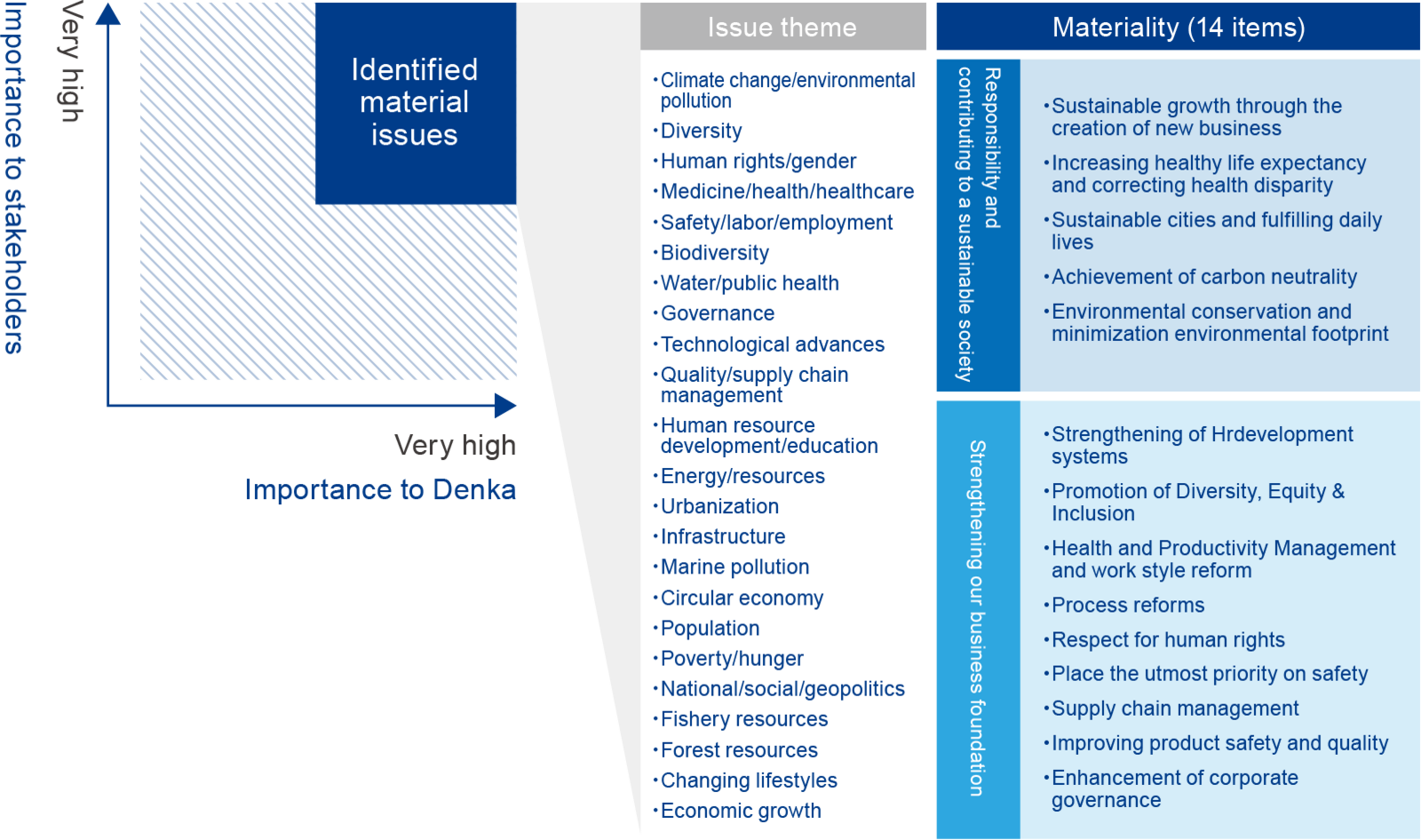
In formulating Management Plan “Mission 2030”, which will begin in fiscal 2023, Denka Group analyzed and evaluated ESG issues over the medium to long term (eight years) leading up to 2030, and reviewed its materiality.
The Sustainability Committee (chaired by the President) has been established within the Executive Division to supervise the proactive and active efforts of the Executive Division to address issues related to sustainability (medium- to long-term sustainability). The committee meets five times a year with the President serving as chairperson, the Executive Officer in charge of the Corporate Planning Department as vice chairperson, and the Executive Officer in charge of the Management Department as a committee member, with Directors, excluding committee members, present as observers.
The Committee deliberates and makes recommendations on sustainability initiatives implemented by the Executive Division and the achievement of non-financial target KPIs (Key Performance Indicators). In implementing these deliberations and recommendations, from the perspective of ensuring transparency and fairness in corporate decision-making and the realization of effective corporate governance, the Committee will consider the impact of risks and profit opportunities on our business activities, taking into account the level of consistency between our efforts to address sustainability issues and our management strategies and issues. The results of these deliberations will be reported to the Board of Directors.
In addition, The Portfolio Transformation Committee (chaired by the President) was established to promote a change to our business portfolio based on three elements: specialty, megatrends, and sustainability. By incorporating such indicators as CO 2 emissions and labor productivity, we aim to achieve our target of 100% three-star businesses by 2030.
 The 1st The Sustainability Committee (July 10, 2023)

Materiality Analysis Map of the Denka Group
| Denka Group ESG Basic Policy |
Materiality (Important Management Issues) |
Mission 2030 KPI (Key Performance Indicator) |
2030 Targets |
|---|---|---|---|
|
|
|
60% reduction from FY2013 (1,000,000t) |
|
150MW | ||
|
76% | ||
|
Continue 1% reduction in energy intensity from previous year | ||
|
|
|
Continue zero waste emissions |
|
Implementation of biodiversity conservation plan in accordance with TNFD and continuation of group-wide awareness-raising activities | ||
|
|
|
Social implementation of PS chemical recycling Consortium Establishment |
|
Sales expansion of LEAF | ||
|
100% | ||
|
|
|
Human Rights in the Group Supply Chain Establishing risk identification and response processes |
|
|
|
Double compared to fiscal 2021 |
|
50% | ||
|
15% | ||
|
85% | ||
|
50% | ||
|
Visualizing engagement and making ongoing improvements | ||
|
30 hours or less/person/year | ||
|
100% | ||
|
― | ||
|
Twice a week | ||
|
80% | ||
|
10% or less | ||
|
40% | ||
|
12% or less | ||
|
|
|
720 people (cumulative total for FY2023-2030) |
|
Main unit and subsidiaries 0.2 or less | ||
|
All group employees | ||
|
|
|
Number of high-risk suppliers: 0 |
|
Conduct questionnaire for all business partners | ||
|
Ecovadis Gold | ||
|
|
|
Zero cases of serious quality accidents |
|
|
|
The number of significant compliance violations: 0 |
|
Planned maintenance based on priority | ||
|
All group employees | ||
|
Disclosure on ESG information sites | ||
|
Dissemination of Vision and Management Plan | ||
|
Establishment of internal control framework for all Group companies | ||
|
Strengthening of management foundations and controls |
| Policy | Non-financial KPIs | 2023 Fiscal Year Results | 2030 Targets |
|---|---|---|---|
| Achievement of carbon neutrality | (1) Reduction of group-wide CO 2 emissions | 28% reduction compared to FY2013 (1.78 million t-CO 2 | 60% reduction from FY2013 (1,000,000t) |
| ②Maximizing renewable energy generation | 146MW | 150MW | |
| ③Renewable energy + electricity mix with non-fossil fuel certificates | 40% | 76% | |
| ④Promoting Group-wide energy conservation | 102% compared to previous fiscal year | Continue 1% reduction from previous year | |
| Increasing healthy life expectancy and correcting health disparity | Concentration on three-star businesses | ー | 100% |
| Sustainable cities and fulfilling daily lives | ①Contribution to decarbonization and recycling-oriented society through the chemical recycling of styrene resins |
|
Establishment of social implementation consortium for PS chemical recycling |
| ②Establishment of CO 2 concrete fixation technology | 32t | Sales expansion of LEAF | |
| Sustainable growth through the creation of new businesses | (Financial KPIs) | ||
| Conservation of the environment and minimization of environmental footprint | ①Continue zero waste emissions | Continue zero waste emissions Standalone: 0.05% Including domestic affiliates: 0.06% |
Continue zero waste emissions |
| ②Addressing nature-related risks such as biodiversity and water based on TNFD |
|
Implementation of biodiversity conservation plan in accordance with TNFD and continuation of group-wide awareness-raising activities | |
| Strengthening of HR development systems | Average training costs (per person) | 69,000 yen / person・year | Double compared to fiscal 2021 |
| Diversity, equity & inclusion | Percentage of female/foreign/experiential hires in management positions | 20% | 50% |
| Paternity leave uptake rate | 53% | 85% | |
| Percentage of mid-career hires | 31% | 50% | |
| Health and productivity management and work style reform | Improving employee engagement | Create action plans for issues extracted from the analysis results of the 3rd employee awareness survey | Visualizing engagement and making ongoing improvements |
| Overtime hours | 147 hours | 30 hours or less/person/year | |
| Taking annual paid leave | 81% | 100% | |
| Introduction of shift breakers | Number of shift breakers adopted15 | ー | |
| Working-from-home rate | 39% | Twice a week | |
| Employees within appropriate weight limits | 65% | 80% | |
| Employees with high stress levels | 15% | 10% or less | |
| Establishing good exercise habits | 34% | 40% | |
| Smokers | 25% | 12% or less | |
| Process reforms | Reduction of 1,000 workers (investment of 50 billion yen over 8 years) | Investment in process reforms: ¥2.3 billion | |
| Respect for Human Rights | Establishment of human rights policy and thorough respect for human rights based on the United Nations Guiding Principles on Business and Human Rights and the United Nations Global Compact |
|
Establishment of process for identifying and addressing human rights risks in group supply chain |
| Safety First | Occupational injury frequency rate | 0.4 | Main unit and subsidiaries 0.2 or less |
| Online training for occupational safety and security | 82% (Conducted for Denka employees around 5 years after joining) | All group employees | |
| Supply chain management | BCP measures based on raw material risk assessment | The Company has summarized the BCP raw material risk assessment. The percentage of items with high risk assessment has decreased from 31% in the first round (April 2020) to 15%. | Number of high-risk suppliers: 0 |
| Procurement questionnaire implementation rate | A total of 732 suppliers of raw materials and fuels were surveyed using the UNGC ESG survey questionnaire, and responses were received from 572 suppliers, or 78%. | Conduct questionnaire for suppliers covering 90% of total procurement cost | |
| Acquisition of high ESG rating | Implementation of EcoVadis score improvement plan | Ecovadis Gold | |
| Improving product safety and quality | Integration of quality control systems, raising of management levels | Inappropriate acts such as UL certification found | Zero cases of serious quality accidents |
| Enhancement of corporate governance | Ongoing improvement of effectiveness of Board of Directors |
|
ー |
| Thorough risk management across the global Group | Inappropriate acts such as UL certification found | The number of significant compliance violations: 0 | |
| Attendance at compliance training | Implementation of E-learning for Code of Conduct for all group employees: Attendance rate of approximately 90% | All group employees | |
| Appropriate operation of the whistle-blowing system and disclosure of responses to whistle-blowing | Disclose 2023 results on ESG information site | Disclosure on ESG information sites | |
| Dissemination of vision and management plan |
|
Dissemination of Vision and Management Plan | |
| Group-wide establishment of internal control framework |
|
Establishment of internal control framework for all Group companies |
|
In response to changes in sustainability issues, social needs, and stakeholder expectations, we will review materiality and non-financial indicators (KPI) as appropriate to reflect our business activities and their mutual impact on the economy, environment, and society in our management.

1. ESG Management Promotion System 2. Review Process ...
Electronics and Innovative Products Life Innovation E...
Signing of the United Nations Global Compact Support for TCFD (Task Force on Climate-related Financial Disclosures) W...
Governance and risk management Indicators and targets Environmental management through CDP...
DENKA was selected in July 2022 as a finalist in the Global Environment Facility (GEF) International Patent System (IPS) for Environmentally Sound Technologies (EST) organized by the World Intellectual Property Organization (WIPO).
May 13, 2022 announcement, January 17, 2023 updateOur company has been participating in the "Future Opening" initiative promoted by the Cabinet Office, the Small and Medium Enterprise Agency, and relevant economic organizations since 2021.