
Updated February 2025
The Denka Group understands compliance not only as the observance of laws and regulations, the Articles of Incorporation, and internal rules and regulations, but also as the observance of corporate ethics and social norms as a good corporate citizen. Compliance is a fundamental prerequisite for conducting business activities, and is therefore a critical management issue. Denka is working to strengthen its group compliance systems on a global level as a management foundation for increasing corporate value into the future.
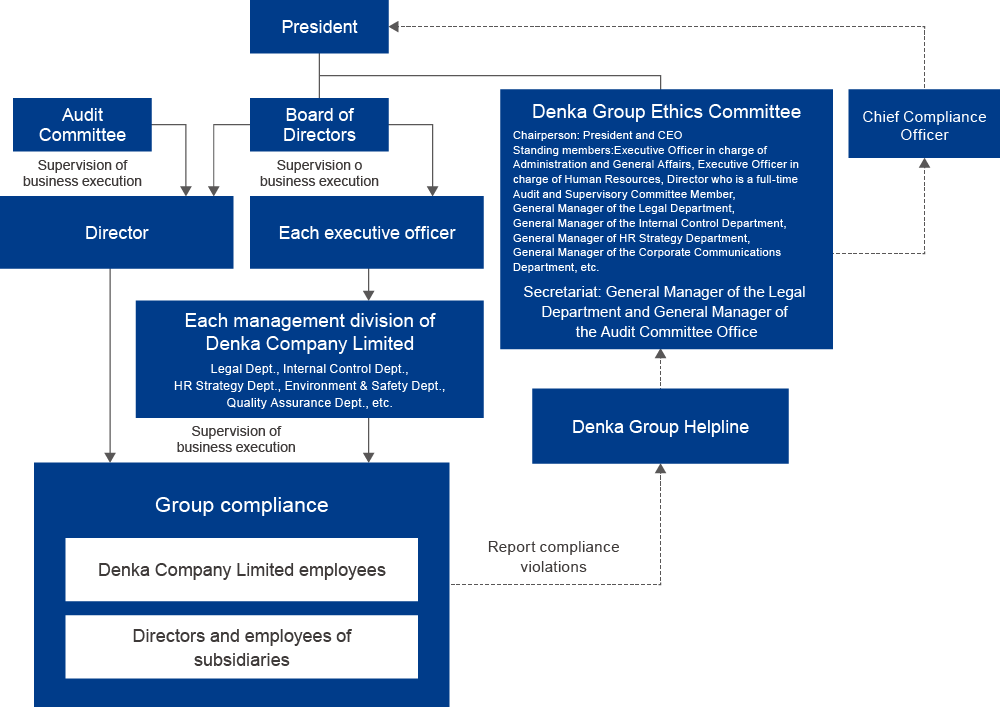
In order to ensure compliance with the Denka Group Ethics Policy, the Denka Group has established the Ethics Committee, chaired by the President, to conduct comprehensive supervision of compliance and report to management. The Legal Department, Internal Control Department, Human Resources Strategy Department, Intellectual Property Department, Environmental & Safety Department, Quality Assurance Department, and related departments are working to ensure compliance in each of their areas of expertise.
To ensure that all officers and employees of the Denka Group, both in Japan and overseas, can act in accordance with the Denka Group Ethical Regulations, we have established the Standards of Business Conduct as a set of business conduct guidelines based on international standards that clarify and specify the provisions of the Denka Group Ethical Regulations.
Furthermore, to build and operate an effective and efficient compliance system throughout the Denka Group, we have created a Legal Hazard Map that analyzes the significance of compliance risks at each Group company.
Denka Group's compliance system
The Denka Group believes that corporate governance is the foundation for gaining the trust and empathy of stakeholders and enhancing corporate value. We strive to ensure transparency and soundness in management and are working to enhance corporate governance.
| Purpose | Efforts | |
|---|---|---|
| 2007年 | Accelerating decision-making | Reduce the number of directors by half and introduce a system of executive officers |
| 2008年 | The Directors monitor and supervise the execution of duties on an equal basis. | Abolishment of titles (Executive Director, Managing Director, etc.) |
| Clear separation between business execution and monitoring/supervisory functions | The authority and position for executing business are delegated from Directors to Executive Officers. | |
| Conduct checks on Directors in a flexible manner | Shorten the term of office of Directors to one year | |
| Strengthening management oversight from external perspectives | By appointing two outside directors, the Company has selected a total of four outside officers, including two outside auditors (as required by law). | |
| Establishment of a system that enables appropriate advice through sufficient exchange of opinions outside of the Board of Directors | Outside directors hold regular exchanges of opinion with the top management | |
| Accelerate decision-making processes by deepening discussions on important management issues | Establishment of Management Committee consisting of Directors and Corporate Auditors (internal) and some Executive Officers | |
| 2015年 | Companies must enhance their governance systems to improve transparency and soundness of management. | Increase the number of outside directors (from 2 to 3) and reduce the number of directors (decrease the number of directors by 2) |
| Establishment of venues for free-spirited and constructive discussions, exchanges of opinions and information, and strengthening of collaboration among internal and external directors and auditors | The Company has strengthened the external Director and Audit & Supervisory Board Member discussion meetings, which were previously held twice a year, and has held Director and Audit & Supervisory Board Member discussion meetings. | |
| Achievement of the best corporate governance for sustainable growth and medium- to long-term enhancement of corporate value | Establishment of Denka Corporate Governance Guidelines | |
| Deepening understanding of our business and invigorating discussions at the Board of Directors | In cases of individual agenda items that require sufficient explanation for outside directors, the Company will provide prior explanations in a more detailed manner. | |
| Facilitate information exchange and shared recognition among outside directors | Holding of "Outside Officer Liaison Meetings" four times a year | |
| 2016年 | Promoting understanding of medium- to long-term and short-term business and research policies | Hold "Business and Research Policy Briefings" (currently "Policy Briefings") twice a year for outside directors |
| Sufficient audit and supervision of Executive Officers' execution of duties | Clarification of the contents of materials for discussion and reports at the Board of Directors | |
| Improving effectiveness of Board of Directors | An analysis and evaluation of the effectiveness of the Board of Directors is conducted every year by all Directors and all Audit & Supervisory Board Members, and the results are disclosed in the Corporate Governance Report. | |
| 2017年 | The Board of Directors receives diverse opinions and advice from outside directors to facilitate transparent and objective decision-making on important management issues, including governance-related matters such as the nomination and remuneration of directors. | Establishment of "Advisory Committee on Management" consisting of all outside directors, all outside auditors, the Chairman, and the President |
| Change name of "Directors and Auditors Discussion Meeting" to "Management Issues Discussion Meeting" | ||
| 2019年 | The Company aims to further enhance corporate governance and increase corporate value by realizing quicker decision-making and further strengthening the supervisory function of the Board of Directors by having Directors who are audit committee members exercise their voting rights at the Board of Directors. | Transition from a company with a board of auditors to Company with Audit and Supervisory Board |
| Change name of "Advisory Committee on Management" to "Nomination and Remuneration Advisory Committee" | ||
| 2021年 | Review of the appointment standards for advisors and consultants after retirement of the Chairman and President | Abolition of the position of Senior Advisor |
| Clarification of the roles of the Board of Directors and executive structure, further enhancing the effectiveness of discussions at the Board of Directors and further speeding up decision-making | The number of Directors was reduced from 12 to 9, and the ratio of Outside Directors to total Directors was increased to over 44%. | |
| 2023年 | Effective committee operation through enhancement of independence and objectivity | Appointment of an outside director as chairperson of the Nomination and Remuneration Advisory Committee |
| Strengthening of incentives | Review of officer remuneration system
|
|
| Activities related to sustainability and progress of non-financial targets and KPIs, and response to risks and profit opportunities | Establishment of "The Sustainability Committee" with an outside director and a full-time audit committee member as observers |
The Denka Group Ethical Regulations establish standards of conduct that must be observed by the officers and employees of Denka Group companies to maximize the corporate value of the Denka Group. To ensure thorough compliance with the Denka Group Ethical Regulations, Denka has established an Ethics Committee chaired by the President. The Ethics Committee conducts comprehensive supervision and reports to management on compliance across the Denka Group, including management of the Business Conduct Standards, which prevent corruption in all forms. Under the Ethics Committee, the Legal Department, which serves as the secretariat for the Ethics Committee, is promoting the establishment of company-wide common regulations and group policies, as well as the implementation of various compliance training programs for the Denka Group, to strengthen our group compliance system on a global level. Furthermore, the Internal Control Department, Human Resources Strategy Department, Intellectual Property Department, Environmental & Safety Department, Quality Assurance Department, and other related departments are responsible for ensuring compliance at the group level in each of their areas of expertise.
Established in October 2019, Revised on July 1, 2023
In October 2019, Denka established the Denka Group Standards of Business Conduct (hereinafter, "Standards of Business Conduct") as internationally standardized guidelines for the purpose of ensuring that all officers and employees of the Denka Group can act in accordance with the Denka Group Ethical Regulations. The items are as follows.
Chapter 1 Basic Rules on Compliance
Chapter 2 Environmental Conservation and Occupational Health and Safety
Chapter 3 Compliance with Antitrust Laws
Chapter 4 Export Control
Chapter 5 Prohibition of Insider Trading
Chapter 6 Safeguarding Personal Information
Chapter 7 Maintaining and Improving Product Quality
Chapter 8 Confidential Information and Intellectual Property
Chapter 9 Preventing Money Laundering and Prohibiting Provision of Benefits to Antisocial Forces
Chapter 10 Prohibiting Bribery and Entertainment/Gifts
Chapter 11 Political Activities and Political Contributions
Chapter 12 Relationship with Local Communities/International Business Guidelines
Chapter 13 Respecting Human Rights in the Workplace and Supply Chain
Chapter 14 Voicing Concerns
The basic rules of Chapter 1 include standards of conduct regarding matters that can easily lead to misconduct by our Employees, such as protecting company assets and their intended use, maintaining accurate records, making correct reports, cooperating with audits and investigations, and avoiding conflicts between the company's interests and those of individuals, in addition to the purposes for establishing standards of conduct.
Denka has established its Business Conduct Standards in Japanese, English, and Chinese, and has distributed these standards in booklet form to all Employees of Denka and its Group companies. Furthermore, these standards are always posted on our intranet, and we are making efforts to ensure that all Employees are aware of them.
 English version
 English version
In the "Legal Hazard Map" prepared by Denka, approximately 10 legal fields related to Denka Group businesses are selected and the severity of compliance risks across the Group is analyzed. Based on this map, the Denka Global Compliance Program is formulated to conduct effective training across the Group and strengthen compliance systems including the establishment and review of Group Policies (common rules for the Group) and company-wide common regulations.
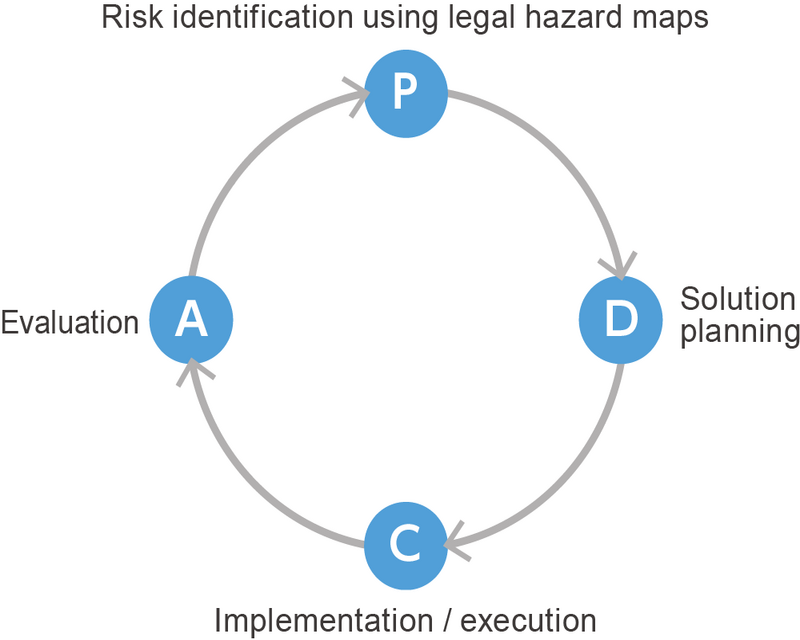

The Legal Department conducts training for all officers and employees of the Denka Group in Japan and overseas on topics such as labor laws, harassment prevention, information security including personal and confidential information protection, competition law compliance, and security export control and economic sanctions regulations, in addition to compliance training based on the Business Conduct Guidelines, which prohibit all forms of corruption, in accordance with the Legal Hazard Map. In fiscal 2023, to promote the establishment of a compliance-first framework and corporate culture across the Denka Group, we will designate a Compliance Enhancement Week to convey a message from the President and conduct compliance surveys based on the content of compliance training and e-learning for employees.
 Group training at Denka headquarters
| Training name | Fiscal 2023 Attendance rate (%) |
Implementing offices | |
|---|---|---|---|
| Face-to-face compliance training ※1 | Total | 94.7% | Denka Headquarters, factories, laboratories, branches and sales offices, some group companies ※2 |
| Denka Global Compliance Program (e-learning) ※3 |
72.8% | Denka Head Office, factories, research laboratories, branches and sales offices, and some group companies | |
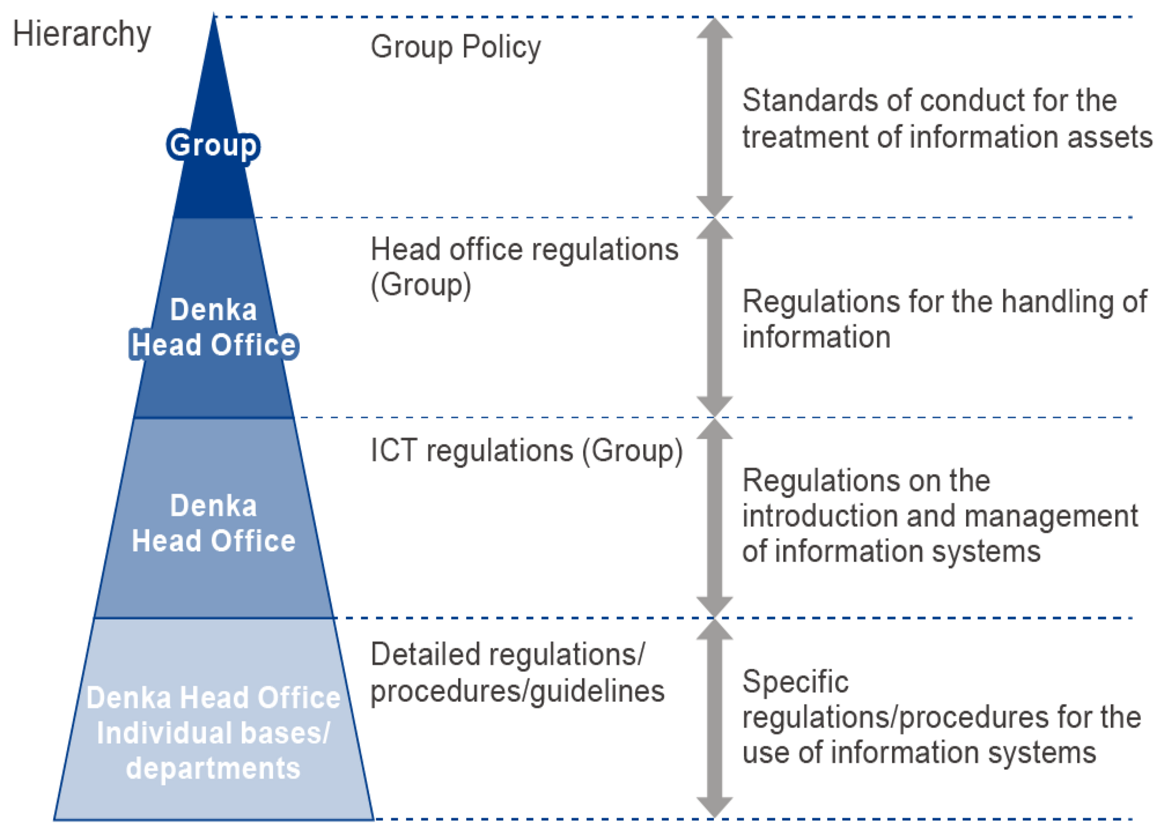
In accordance with ISO27001, an international standard for information security, Denka established and reviewed the following group policies related to information security and ICT governance, which were implemented in April 2021: "Basic Policy on Information Security," "Denka Group ICT Governance Policy," "Denka Group Information Security Policy," "Denka Group ICT System Usage Policy," and "Denka Group Secrecy Policy." Denka plans and conducts training on information security based on each group policy for Denka Group officers and employees, and strives to raise awareness of these policies.
Information Management Regulations System Diagram (Image)

Our Company has established the Core Values of "Integrity" and "Innovation" as the foundation of our corporate activities. Based on these Core Values, we will continue to respond to the expectations and trust of many stakeholders, including shareholders, customers, local communities, and employees.
Our basic policy on BCP is as follows. Even in the event of a crisis or disaster that has a significant impact on our business activities, we will prioritize the safety of human life...
Our Philosophy and StandardsThe Denka Group has established materiality (important management issues) that it should address to achieve the SDGs. One of these is the...
Policy on the operation of the Board of Directors and roles and responsibilities Number of meetings held and attendance of each committee Implementation evaluation of the Board of Directors ...
List of DirectorsRepresentative Director, ChairmanToshio Imai(April 1982...
The Denka Group understands that compliance goes beyond the observance of laws and regulations, the Articles of Incorporation, and internal rules and regulations. It also includes the observance of corporate ethics and social norms as a good corporate citizen.
The Denka Group Code of Ethics establishes standards of conduct that must be followed by officers and employees of Denka Group companies in order to maximize corporate value. Denka is...
Established in October 2019, revised on July 1, 2023 Denka has established the Denka Group Ethics Regulations to ensure that all officers and employees of the Denka Group act in accordance with these Regulations.
In the "Legal Hazard Map" prepared by Denka, approximately 10 legal fields related to Denka Group businesses are selected to identify compliance risks across the Group.
The Legal Department conducts compliance training based on the Business Conduct Guidelines, which prohibit all forms of corruption, and the Legal Hazard Map.
Denka has established the Information Security Group Policy in accordance with ISO27001, an international standard for information security.
Denka's Risk Management System Integrated risk management and Risk Management Committee ...
1. Introduction 2. Persons Targeted and Contents 3. How to Make Reports 4. Response After Receipt of Reports 5. Protection of Whistleblowers
In order for Denka Group companies to conduct fair transactions with customers and suppliers, it is essential to examine the terms of contracts from legal and business perspectives...
Measures to Prevent CorruptionThe Denka Group prohibits all forms of corruption, including acts that violate laws and regulations such as bribery and excessive entertainment and gifts that go beyond common social practices...
Denka prohibits the export of products and technologies that may lead to the development and manufacture of weapons of mass destruction in accordance with the security export control established by the Denka Group Ethical Standards and Denka's company-wide common...
Denka, in order to maintain the fairness of securities transactions and the trust in securities markets, as well as to prevent the illicit use of the Company’s information assets, has established the Denka Group Ethical Guidelines and...
The Denka Group has established the Denka Group Ethical Regulations as the foundation of its compliance system to set forth standards of conduct for the entire Denka Group. In addition, the Denka Group has put in place the Denka Group Code of Conduct and the Denka Group CSR Procurement Guidelines to further promote compliance.
Strengthening of group ICT governance Information security basic policy Management of information posted on website Information se...
[Basic Policy] Main Intellectual Property Activities Intellectual Property Activities [Basic Policy]...
Basic Policy (Quality Policy) Quality assurance system and measures to prevent recurrence of quality misconduct Product safety and quality risk assessment...
In the Electronics and Innovative Products Division, we conduct a customer satisfaction survey once a year to accurately respond to customer requests and reflect the evaluations received in our quality assurance activities...