
September 2026 Update
The Company’s Board of Directors functions as a decision-making body and a supervisory body for the execution of operations in order to achieve the sustainable enhancement of corporate value. The Board of Directors conducts its activities based on the following operational policies to ensure the transparency and soundness of management.
The Board of Directors has the following roles and responsibilities in accordance with the Companies Act and internal regulations.
| Scope | Unit | 2023年度 | 2024年度 | 2025年度 | |||
|---|---|---|---|---|---|---|---|
| Number of Board of Directors meetings | Non-Consolidated | Times | 14 | 15 | 18 | ||
| Number of audit committee meetings | Non-Consolidated | Times | 14 | 13 | 14 | ||
| Number of The Sustainability Committee held | Non-Consolidated | Times | 4 | 5 | 5 | ||
| Status of meetings of the Nomination and Remuneration Advisory Committee and individual attendance rates of Directors | Number of times held | Non-Consolidated | Times | 4 | 6 | 11 | |
| Attendance rate of committee members | Non-Consolidated | % | 100% | 100% | 100% | ||
| Attendance rate of individual Directors | YAMAMOTO Manabu | Non-Consolidated | % | 100% | 100% | ー | |
| Toshio Imai | Non-Consolidated | % | 100% | 100% | 100% | ||
| Ryosuke Fukuda (※2) | Non-Consolidated | % | 100% | 100% | ー | ||
| Rumiko Nakata (※2) | Non-Consolidated | % | ー | 100% | 100% | ||
| Toshio Kinoshita | Non-Consolidated | % | 100% | 100% | 100% | ||
| Akiyoshi Yamamoto | Non-Consolidated | % | 100% | 100% | 100% | ||
| Miyuki Matoba | Non-Consolidated | % | 100% | 100% | 100% | ||
The Company is making ongoing efforts to optimize corporate governance. Each year, the Directors evaluate the operation of the Board of Directors and their own contributions to enhance the effectiveness of governance, identify issues, and make improvements. The results of these evaluations are disclosed in summary form, and after confirming the status of improvements to issues recognized in the previous fiscal year, new issues are identified, and ongoing governance reforms are promoted based on the PDCA cycle.
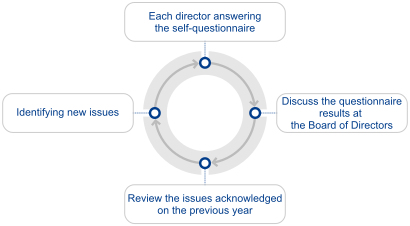
Past Efforts for Evaluating Implementation Status (Please refer to the latest DENKA Report)
When appointing directors, the Company appoints candidates in a balanced manner based on diverse knowledge, experience, and capabilities, and believes that it is important to have a composition with diversity in terms of gender, internationality, and career history. Based on these beliefs, the Company appoints director candidates in accordance with the appointment standards for internal and external directors. Furthermore, in order for the directors that constitute the Board of Directors to be able to focus on monitoring and supervising the execution of duties from an equal position, the Company has, in principle, abolished the positions of directors (Executive Managing Director, Managing Director, etc.). In addition, in order for checks on directors (excluding audit committee members) to be conducted in a flexible manner at the General Meeting of Shareholders, the Company has set the term of office for directors at one year.
The Denka Group has identified the following important skills as knowledge required for promoting Mission 2030: corporate management/management planning, human resource value creation, finance/accounting, ESG/sustainability, technology/manufacturing, and digital transformation.
| Skills | Reason for selecting skills | |
|---|---|---|
| Corporate Management / Corporate Planning | To achieve the Denka Vision, Directors with abundant management experience and track records are required to formulate and review management plans and supervise the execution of operations aimed at achieving those plans. | |
| Human Resources Value Creation | In order to achieve HR investment and system reform, a director with abundant knowledge and experience in HR value creation is necessary to realize a company that allows each employee to feel self-fulfillment and growth. | |
| Global business | In order to become specialists who make the world a better place with the power of chemistry, as stated in our purpose in our vision, we need directors who have extensive global business experience. | |
| Financial strategy / Accounting | Companies must have directors with solid knowledge and experience in financial strategy and accounting in order to improve profitability and efficiency by pursuing optimal capital structure and advancing selection and concentration of businesses in addition to disclosing accurate financial information. | |
| Legal and Compliance | In order to appropriately respond to increasingly complex laws and regulations in Japan and overseas and conduct fair and trustworthy corporate activities, it is necessary to have directors with solid knowledge and experience in the legal and compliance fields. | |
| ESG and Sustainability | E (Environment) | In order to fulfill our corporate social responsibilities, it is essential to address the three issues of "achievement of carbon neutrality," "sustainable cities and fulfilling daily lives," and "environmental conservation and minimization of environmental footprint," which are prerequisites for continuing our business. To this end, we need directors who possess extensive knowledge and experience in E (environment). |
| S (Social) | In order to fulfill our corporate social responsibility through the respect of human rights and participation in the formation of better local communities, in addition to providing safe and high-quality products, we need directors with solid knowledge and experience in S (Social) matters. | |
| G (Governance) | In order to fulfill our social responsibilities as a corporate citizen, it is essential to establish a more advanced and effective corporate governance system based on transparency and fairness under high ethical standards. To this end, it is necessary to have directors with a solid knowledge and experience of governance. | |
| Business Value Creation and Marketing | In the three focus areas of ICT & Energy, Healthcare, and Sustainable Living, we aim to transform our business portfolio by achieving our target of 100% three-star businesses, which meet the three criteria of specialty, megatrends, and sustainability. To facilitate this transformation, we need directors with deep market insights and extensive business experience based on a broad perspective. | |
| R&D / Intellectual Property | In the three focus areas of ICT & Energy, Healthcare, and Sustainable Living, to create business value, in addition to a track record of promoting innovation, we need directors who have a deep knowledge of science and technology and are familiar with our technologies and intellectual property. | |
| Technology / Manufacturing | To facilitate the improvement of productivity through process innovation in the creation of management value and the establishment of a workplace environment that is safe and trusted products, it is essential to have directors who are well-versed in technology and possess extensive experience and sound knowledge in manufacturing sites. | |
| DX | In order to promote business model and organizational reforms through process innovation, it is necessary to have Directors who possess deep knowledge and extensive experience regarding digital technologies and data utilization, as well as the ability to understand and analyze our business and operations and bring about reform. | |
| Attribute | Skills | ||||||||||||||||
|---|---|---|---|---|---|---|---|---|---|---|---|---|---|---|---|---|---|
| Independent Outside |
Number of Years in Office |
Gender | Corporate Management / Corporate Planning | Human Resources Value Creation |
Global business | Financial strategy / Accounting | Legal / Compliance |
ESG / sustainability |
Business Value Creation and Marketing | R&D / Intellectual Property | Technology / Manufacturing | DX | |||||
| E (Environment) |
S (Social) |
G (Governance) |
|||||||||||||||
| Chairman of the Board | Toshio Imai | 7 | M | 〇 | 〇 | 〇 | 〇 | 〇 | 〇 | ||||||||
| President and Representative Director | Ishida Ikuo | President, Executive Officer | 3 | M | 〇 | 〇 | 〇 | 〇 | 〇 | 〇 | |||||||
| Directors | RIMIRU HAYASHIDA | Executive Officer | 1 | M | 〇 | 〇 | 〇 | ||||||||||
| Directors | Masanobu Kousaka | Executive Officer | 1 | M | 〇 | 〇 | 〇 | 〇 | 〇 | 〇 | |||||||
| Directors | RUMIKO NAKADA | 〇 | 2 | F | 〇 | 〇 | 〇 | ||||||||||
| Directors | Michael Uchida | Full-time audit committee member | 3 | M | 〇 | 〇 | 〇 | 〇 | 〇 | ||||||||
| Directors | Toshio Kinoshita | audit committee member | 〇 | 11 | M | 〇 | 〇 | 〇 | |||||||||
| Directors | Akiyoshi Yamamoto | audit committee member | 〇 | 11 | M | 〇 | 〇 | 〇 | 〇 | ||||||||
| Directors | Miyuki Matoba | audit committee member | 〇 | 5 | F | 〇 | 〇 | 〇 | 〇 | ||||||||
| Hara Takashi | Executive Officer | M | 〇 | 〇 | 〇 | 〇 | 〇 | 〇 | |||||||||
| Hiroto Horiuchi | Executive Officer | M | 〇 | 〇 | 〇 | 〇 | |||||||||||
| Yoshio Kawamura | Executive Officer | M | 〇 | 〇 | 〇 | 〇 | 〇 | 〇 |
| Scope Notes | Scope | Unit | 2023年度 | 2024年 | 2025年 | ||
|---|---|---|---|---|---|---|---|
| Number of Directors (Consolidated) |
Total | Including outside directors | Consolidated | People | 76 | 79 | 88 |
| of which are male employees | Including outside directors | Consolidated | People | 75 | 77 | 86 | |
| of which are female employees | Including outside directors | Consolidated | People | 1 | 2 | 2 | |
| Percentage of female employees | Including outside directors | Consolidated | % | 1% | 3% | 2% | |
| Number of Directors (Company) |
Total | Including outside directors | Non-Consolidated | People | 9 | 9 | 9 |
| of which are male employees | Including outside directors | Non-Consolidated | People | 8 | 7 | 7 | |
| of which are female employees | Including outside directors | Non-Consolidated | People | 1 | 2 | 2 | |
| Percentage of female employees | Including outside directors | Non-Consolidated | % | 11% | 22% | 22% | |
| Percentage of outside directors | Number of directors÷Number of outside directors | Non-Consolidated | % | 44% | 44% | 44% | |
| Number of audit committee members | Total | Including outside directors | Non-Consolidated | People | 4 | 4 | 4 |
| of which are male employees | Including outside directors | Non-Consolidated | People | 3 | 3 | 3 | |
| of which are female employees | Including outside directors | Non-Consolidated | People | 1 | 1 | 1 | |
| Percentage of female employees | Including outside directors | Non-Consolidated | % | 25% | 25% | 25% | |
| Number of outside directors | Total | Non-Consolidated | People | 4 | 4 | 4 | |
| of which are male employees | Non-Consolidated | People | 3 | 2 | 2 | ||
| of which are female employees | Non-Consolidated | People | 1 | 2 | 2 | ||
| Percentage of female employees | Directors÷Outside directors | Non-Consolidated | % | 25% | 50% | 50% | |
In order to strengthen the supervisory function of the Board of Directors, the Company has established a policy to maintain a ratio of independent outside directors of at least one-third. Furthermore, the Company selects candidates based on substantial criteria, such as whether or not the candidate is expected to contribute to the enhancement of the Company’s corporate value as an independent officer. Specifically, in addition to the externality requirements stipulated in the Companies Act, the Company has established the following standards based on the independence standards set forth by the Tokyo Stock Exchange.
The independence standards for outside directors of the Company are as follows: persons who do not meet any of the requirements set forth in 1 to 5 below.
Regarding the remuneration of Directors (excluding Directors who are audit committee members), within the total amount resolved at the General Meeting of Shareholders, remuneration is provided according to the roles and responsibilities of each Director, and to enhance objectivity and transparency, the decision is made at the Board of Directors meeting after receiving advice and recommendations from the Nomination and Remuneration Advisory Committee, and established as an internal rule. The remuneration system for Directors consists of a fixed monthly basic remuneration, performance-linked remuneration in cash aimed at raising awareness of company-wide and individual performance for each fiscal year as a sound incentive for sustainable growth, and stock remuneration aimed at raising awareness of improving medium- to long-term performance and increasing corporate value. However, considering the nature of their duties, outside Directors and non-executive Directors receive only basic remuneration.

The remuneration of Directors is determined in accordance with their roles and responsibilities, taking into consideration the level of employee salaries, and fixed amounts are paid in cash every month.
Performance-linked remuneration consists of company-wide performance-linked remuneration and individual performance-linked remuneration. However, the Chairman and President are only provided with company-wide performance-linked remuneration, and the Chairman (non-executive director) without representation rights is not provided with remuneration.
Company-wide performance-linked remuneration is linked to consolidated operating profit, which is a key target value in the Company’s management plan, and the total amount to be paid is determined and allocated according to the roles and responsibilities of each Director, and paid promptly after the financial results are finalized. However, if consolidated operating profit is less than a certain amount, if a large special loss occurs, or if a serious compliance violation occurs, remuneration will not be paid or the amount paid will be reduced.
Individual performance-linked remuneration is paid after the financial results are finalized in accordance with internal regulations established by the Company in advance, linked to individual evaluations of the achievement of financial and non-financial targets for each Director.
Stock-based compensation is a system that utilizes a trust scheme, and the Company provides Directors with Company shares through the trust at the time of their retirement based on the number of points granted monthly according to their position in accordance with the Company’s share grant regulations.
The amount contributed to the trust as funds required for granting Company shares to Directors is capped at 40 million yen per year.
The contents of individual Directors' remuneration, etc. are determined by the Board of Directors based on the recommendations of the Nomination and Remuneration Advisory Committee, and established as internal rules.
Furthermore, with regard to individual performance-linked remuneration for Directors, the President, to whom this authority has been delegated, evaluates each individual based on internal rules determined by the Board of Directors and makes a decision. The Board of Directors establishes the amounts of remuneration linked to individual evaluations in advance in internal rules, and receives reports on the contents, in order to ensure that this authority is appropriately exercised by the President.
| Category | Staff | Remuneration amount | Breakdown | |||||
|---|---|---|---|---|---|---|---|---|
| Monetary remuneration | Stock compensation | |||||||
| Basic remuneration | Performance-linked remuneration | |||||||
| Staff | Total | Staff | Total | Staff | Total | |||
| Directors (excluding directors who are audit committee members) |
7 | 274 million yen | 7 | 184 million yen | 4 | 63 million yen | 6 | 26 million yen |
| (including Outside Directors) | (1) | (13) | (1) | (13) | (―) | (―) | (―) | (―) |
| Director (audit committee member) |
4 | 78 | 4 | 78 | ― | ― | ― | ― |
| (including Outside Directors) | (3) | (39) | (3) | (39) | (―) | (―) | (―) | (―) |
| Total | 11 | 352 | 11 | 262 | 4 | 63 | 6 | 26 |
| (including Outside Directors) | (4) | (52) | (4) | (52) | (―) | (―) | (―) | (―) |

We recognize that our corporate activities have an impact on the environment and society, and we strive to fulfill our responsibilities to stakeholders through our business activities. In order to respond to the expectations and trust of many stakeholders including shareholders, customers, local communities, and employees, we have established the D...
Our basic policy on BCP is as follows. In the event of a crisis or disaster that has a significant impact on our business activities, we will implement our BCP to ensure the safety of our employees and the continuity of our business.
Our Philosophy and Standards Group-wide Awareness and Thorough Implementation Monitoring...
Policy on the Operation of the Board of Directors and Roles and Responsibilities Number of Meetings Held and Attendance at Each Committee ...
List of DirectorsRepresentative Director, ChairmanToshio Imai(April 1982)
1. Introduction 2. Intended Users and Content 3. How to Use 4. Response After Whistleblowing 5. Com...
In order for the Denka Group companies to conduct fair transactions with customers and suppliers, the Denka Group companies must examine the contents of contracts from legal and business perspectives...
Measures to Prevent Bribery and Corruption Responding to Anti-social Forces, Money Laundering and Other Crimes
Denka prohibits the export of products and technologies that can be used for the development and manufacture of weapons of mass destruction. In accordance with the Denka Group Ethics Regulations and Denka's...
Denka is committed to maintaining the fairness of securities transactions and the trust in securities markets, as well as preventing the illicit use of the Company’s information assets, and has therefore established the Denka Group Code of Conduct.
The Denka Group has established the Denka Group Ethical Regulations as the foundation of its compliance system to set forth standards of conduct for the entire Denka Group. In addition, the Denka Group has put in place the Denka Group Code of Conduct and the Denka Group CSR Procurement Guidelines to further promote compliance.
Strengthening group ICT governance Basic information security policy ...
Policy: Main Intellectual Property Activities: Intellectual property applications aimed at creating business value...
Basic Policy (Quality Policy) Quality assurance system, Measures to prevent recurrence of quality misconduct ...
In the Electronics and Innovative Products Division, we conduct a customer satisfaction survey once a year to accurately respond to customer requests and reflect the evaluations received in our quality assurance activities...
Composition of Board of Directors and audit committee Number of meetings and attendance of each committee Social contribution...